Founder

An experienced operator adapting SEO discipline to AI-era retrieval.

A.L. MacFarland is the Founder of AEO Pro Lab, a page-readiness review that helps SEO teams understand whether their pages are clear, useful, and ready for modern search.

After 20+ years in technical SEO, ecommerce, and page architecture, the work has shifted from optimizing rank position to reviewing page readiness, helping teams see whether a page is clear, well-structured, and trustworthy before recommending change.

Early Thinking

Writing about the shift before it became the conversation.

Years before AI-mediated search and AEO became daily search-industry talking points, A.L. MacFarland was writing about the need for modern SEO to move beyond passive reporting and dashboard-hoarding.

In his LinkedIn article, “Why Modern SEO Needs Creative Risk Takers, Not Data Hoarders,” he argued that the next phase of SEO would reward operators who could connect data, creativity, experimentation, and judgment, not just collect more reports.

Search has since stopped being only a list of ranked pages. It is becoming a machine-mediated layer where systems select, summarize, cite, and reuse information on behalf of users.

AEO Pro Lab exists for that environment.

Early Thinking
Published before AEO became mainstream

A documented argument for judgment-led SEO before AI-mediated discovery became the daily industry conversation.

Read the LinkedIn article →
Platform Focus

From rankings to page readiness.

Traditional SEO reporting often shows what changed after the fact.

AEO Pro Lab is being built to answer a more urgent question:

Is this page clear, useful, and ready for modern search?

AEO Pro Lab exists because modern visibility is no longer only about whether a page ranks. It is also about whether the page can be understood accurately, supported by visible evidence, and reused without distorting the business meaning.

01

Clear brand & topic

Whether the page is clear about its primary subject, with consistent references that do not shift mid-document.

02

Clear, useful structure

Whether key points are easy to find, without readers having to reconstruct meaning from scattered prose.

03

Structured data that matches the page

Whether structured data reflects what the page actually shows, not what the page wishes were there.

04

Page-level trust

Whether anything on the page introduces verification problems: ambiguous authorship, missing dates, unsupported assertions, or unclear source context.

05

Clear source support

Whether claims are supported with sources, dates, and qualifiers that systems and humans can weigh.

06

Consistent visible and structured information

Whether what a reader sees matches what a parser extracts. Drift between them costs trust.

This is not a promise of rankings, AI citations, or guaranteed visibility. It is a practical readiness layer for the search environment already forming.

Documented Research

Research-backed, not trend-chased.

AEO Pro Lab grows out of documented work on how search, trust, machine-readable meaning, and AI-mediated discovery are changing.

A.L. MacFarland has published research on Universal Search Optimization, Semantic Scaffolding, the Semantic Mesh, agentic AI auditability, provenance, and governance-aware AI workflows.

His work argues that visibility is moving from page presence toward structured trust: content must be machine-legible, evidence-aware, entity-stable, and reusable as a reliable unit of meaning.

Zenodo · Research
Semantic Scaffolding & the Semantic Mesh

Visibility is no longer just ranking. In AI-mediated discovery, content must become machine-legible, verifiable, and reusable as stable units of meaning. This directly informs AEO Pro Lab's focus on content clarity, page structure, source support, and modern search readiness.

Semantic Scaffolding and the Emergence of the Semantic Mesh: Toward a Framework for Universal Search Optimization (USO 3.0). DOI: 10.5281/zenodo.20795838. Related research: Agentive Swarm Coding for Semantic Resilience.

View on Zenodo →
Zenodo · Research
Agentive Swarm Coding for Semantic Resilience

Modern AI workflows need deterministic gates, provenance, audit trails, and human oversight to remain trustworthy. The same thinking informs AEO Pro Lab's approach to clear, well-sourced page-readiness reviews.

Agentive Swarm Coding for Semantic Resilience: A Design-Based Framework for Auditable AI Code Generation. DOI: 10.5281/zenodo.17184867. Related research: Semantic Scaffolding & the Semantic Mesh.

View on Zenodo →

Presented as documented research and founder approach, not a guarantee of rankings, AI citations, or universal acceptance.

Early Signal

Early proof of direction, not a ranking promise.

This is early proof of direction from an anonymized client site. It was not built to rank, and growing domain authority was never a goal of the test. There were no ads and no paid promotion of any kind; the intent was purely to establish baseline signals for analysis. The single metric under examination was citation: whether clear, structured content gets selected and reused by AI and answer engines. In a recent Bing Webmaster Tools citation sample, the client site generated 20.5K citations across a 30-day window, with an average of 36 cited pages. This is directional citation evidence, not proof of rankings, traffic, conversions, or recommendations.
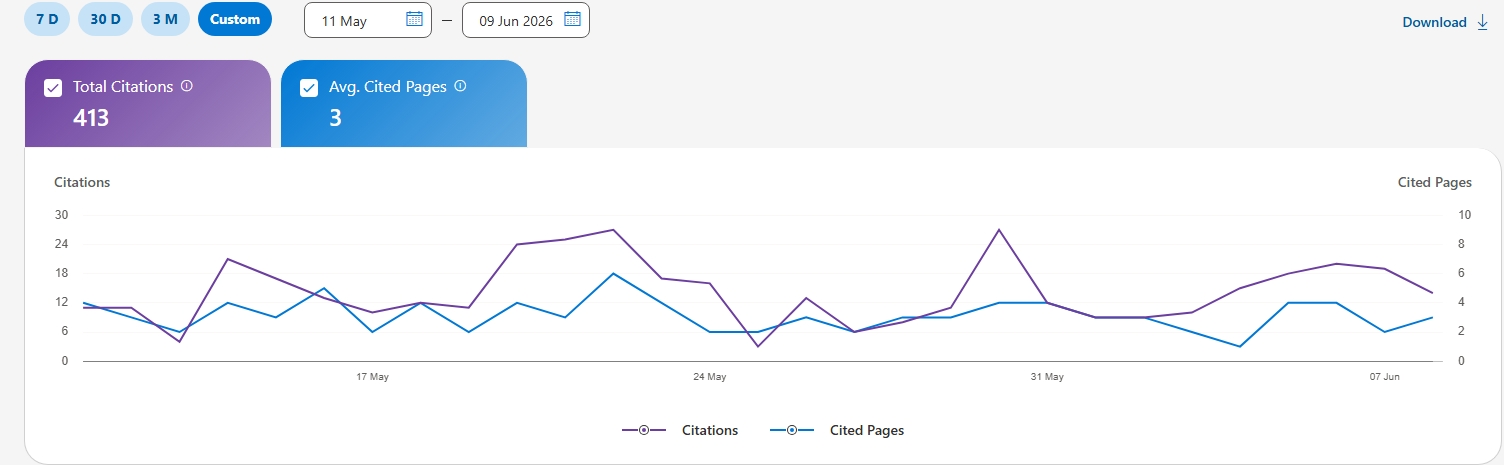
Bing Webmaster Tools AI Performance report from a 30-day citation sample showing 20.5K total citations and an average of 36 cited pages between 31 May and 28 June 2026
Source: Bing Webmaster Tools, AI Performance report from an anonymized client site, a 30-day citation sample (31 May to 28 June 2026) showing content cited 20.5K times as a source in AI-generated answers, drawn from an average of 36 cited pages. Directional citation evidence only, not a ranking, a domain authority score, or a click count.

It is an early signal that clear, structured content can travel when the page gives systems something clear to work with, which means the approach is now ready for scalability testing and further citation development.

The real proof, though, is not one metric. It is the market shift itself: Google's AI Overviews, answer engines, AI assistants, and citation-based discovery are all moving search toward a world where being ranked is no longer the same as being selected.

Founder Background

Two decades of search work, now focused on what comes next.

A.L. MacFarland has more than 20 years of experience across technical SEO, ecommerce, page architecture, structured data, content systems, and search visibility strategy.

He has built, audited, or supported search and web systems for organizations including Walmart, IMDBpro, Sam's Club, NYCastings, IIL, and dozens of smaller operators.

The work is hands-on: live sites, real audits, and structural diagnoses of why pages that look polished may still fail as answer sources.

His work combines technical SEO discipline with creative risk-taking, the ability to test new search behavior before it becomes standard playbook advice.

That operating mindset is the foundation of AEO Pro Lab.

Clarity

Built for clearer interpretation

AEO Pro Lab is built around a practical problem: businesses are increasingly described, summarized, and compared by systems they do not control. When page information is unclear, unsupported, or inconsistent, the business can be misread. AEO Pro Lab helps teams identify where stronger page clarity and evidence support may be needed.

Why It Exists

Most SEO tools tell teams what happened.

AEO Pro Lab helps explain what may prevent a page from being used.

AEO Pro Lab is being built to help teams review whether a page is clear, useful, well-structured, and trustworthy for the next phase of search. For more on how we work, read our approach.

Because in AI-mediated discovery, visibility is no longer only about where a page ranks.

It is also about whether systems can understand it, trust it, and reuse it.

Rights & Citation

Content rights and published framework citation.

Content published on AEO Pro Lab is protected by copyright. The diagnostic logic, review prompts, scoring criteria, workflow structure, report architecture, and implementation methods behind AEO Pro Lab are proprietary and are not published for reuse. The underlying research framework is separately published and citable below.

Citation
Semantic Scaffolding and the Emergence of the Semantic Mesh: Toward a Framework for Universal Search Optimization (USO 3.0)

A.L. MacFarland (2026). Semantic Scaffolding and the Emergence of the Semantic Mesh: Toward a Framework for Universal Search Optimization (USO 3.0). Preprint (v6.0). Publisher: Zenodo. Published 2026-06-22. Language: English. DOI: 10.5281/zenodo.20795838.

View on Zenodo →

© 2026 AEO Pro Lab. All rights reserved. Please cite the published framework above when referencing the research.

Related Field Note

Visibility Architect and Universal Search Optimization.

A.L. MacFarland has written publicly about the emerging role of the Visibility Architect and the shift from traditional search visibility toward AI-mediated discovery, where businesses are not only found, but interpreted, summarized, compared, and selected by machine-assisted systems.

Read the LinkedIn field note: Visibility Architect and Universal Search Optimization →