| Task | Best Approach | Why | Risk |
|---|---|---|---|
| Test AI selection eligibility | Ask AI search tools category-specific buying questions and check if your brand appears | Reveals whether you are in the shortlist or invisible to the system | Ignoring this test leaves you optimizing for a scoreboard that no longer determines outcomes |
| Improve shortlist inclusion | Ensure clear pricing, consistent identity, strong reviews, and structured service data | AI systems select brands that are easy to compare and safe to recommend | Ambiguity in any of these signals causes silent exclusion without warning |
| Adapt SEO measurement | Track selection and consideration metrics, not just rankings and traffic | Ranking drops may not explain demand loss if the real problem is upstream exclusion | Continuing to measure only rankings misses the shift entirely |
| Option | When to Use | Strength | Limitation |
|---|---|---|---|
| Traditional SEO (rank and click) | Markets where users still browse 10 results | Established playbook with clear metrics | Fails when AI narrows the market before the click happens |
| Selection engineering | Markets where AI agents curate shortlists | Directly addresses how AI systems choose brands to recommend | No standard tooling yet; measurement is immature |
| Brand consistency cleanup | Any business with contradictory information across platforms | Resolves the single most common reason AI systems skip a brand | Time-intensive across multiple surfaces; easy to deprioritize |
The Part Nobody Wants to Say Out Loud
There is another reason this future may get tighter, not looser.
Once AI-generated answers become valuable enough to copy, exploit, or drain at scale, platforms have every reason to meter access, monitor usage, raise prices, and reserve stronger capabilities for premium users and institutional customers.
That means search may not only become more convenient.
It may become more controlled.
The public gets fast answers. Power users get deeper systems. Advertisers get embedded placement. And SEO has to compete inside a layer where visibility is not just ranked, but selected.
The future of search is not just answer engines. It is controlled access to intelligence.
Possible 2028 Scenario
You type a request.
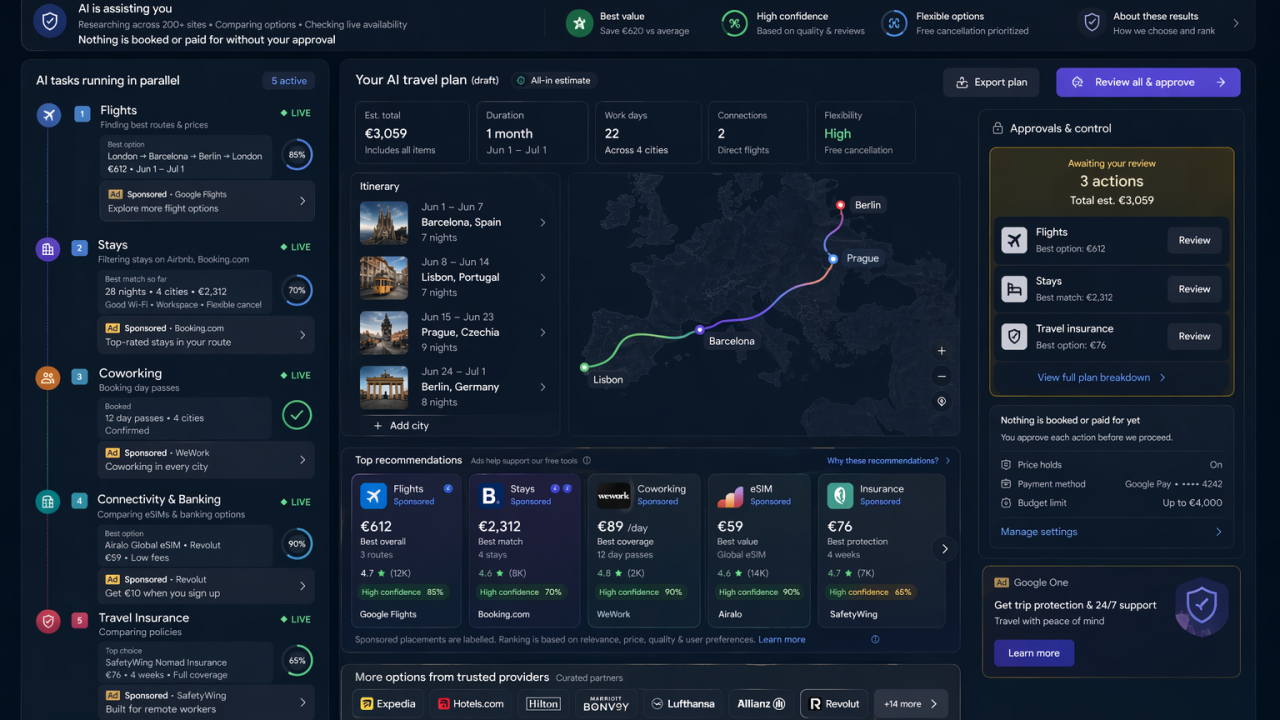
Plan my one-month Europe work trip. Find a roofer who can come today and offers financing. Compare CRMs for a 20-person sales team. Rebook my delayed flight with aisle seats only. Replace the office printer without buying another cursed machine from 2017.
You do not get ten links.
You do not get ten tabs.
You do not get a weekend side quest involving review sites, Reddit threads, affiliate blogs, and three suspicious comparison pages written by someone named Editorial Team.
You get a shortlist.
Three or four options. Pre-compared. Pre-filtered. Prices checked. Policies summarized. Availability scanned. Next steps ready.
Search does the messy part first.
And that is exactly why it kind of sucks for SEO.
The Old SEO Win Was Visibility
For years, the game was straightforward.
Show up. Rank higher. Earn the click. Convert the visit.
It was imperfect, noisy, and occasionally ridiculous, but it was understandable.
If you were position one, life felt better.
If you were position nine, you became interested in technical audits and prayer.
But in a shortlist environment, ranking is no longer the whole event.
The user may never browse the market the way they used to.
The system may narrow the market before the click ever happens.
The New SEO Problem Is Selection
This is where many people misunderstand the shift.
The threat is not that search disappears.
The threat is that comparison gets centralized.
Instead of users visiting ten vendors and making a messy human decision, the system evaluates the field first and presents a cleaner set of choices.
That means many businesses will not lose rankings.
They will lose consideration.
Quietly.
No penalty. No dramatic drop. No warning siren.
Just fewer appearances in the moments that matter most.
Why This Future Is Plausible
The incentives are already here.
- Users want convenience. Most people would rather ask once than research twelve times.
- Platforms want retention. Keeping users inside the experience is worth real money.
- Advertisers want outcomes. A completed booking is better than a curious click.
- Brands want inclusion. If the shortlist becomes the gateway, nobody wants to be vendor number five staring through the glass.
And the technology is already moving.
Google has described future Search as more agentic, while OpenAI and other AI platforms are already testing systems that can complete multi-step tasks through live interfaces.
Systems can compare products, summarize reviews, scan policies, remember preferences, check availability, and coordinate tasks with approvals.
We do not need science fiction.
We need one more product cycle.
How Google Makes Money
Old Google monetized attention.
New Google may monetize decision flow.
That looks like:
- sponsored recommendation slots inside the shortlist
- preferred providers with deeper integrations
- booking commissions
- lead fees
- checkout rails
- finance and insurance partnerships
- premium placement disguised as convenience
The old ad asked:
Click here.
The new ad may say:
Recommended option. Review and approve.
That is a much stronger ad unit.
Why It Sucks for SEO
Because the feedback loop gets harder to see.
The user may never compare page titles.
They may never see your beautiful meta description that took three meetings to approve.
They may never admire the blog post your team called a pillar asset while everyone privately hated it.
But the deeper problem is not wounded SEO pride.
It is that teams may keep publishing, optimizing, and reporting while the actual buying moments are being decided upstream inside systems they barely measure.
A brand can work hard, rank decently, and still lose the shortlist.
That is the uncomfortable part.
The loss may not show up as a clean ranking drop.
It may show up as softer demand, stranger lead quality, fewer high-intent inquiries, or a vague sense that the market got quieter.
That is worse than a ranking drop.
At least a ranking drop has the decency to insult you directly.
What Actually Wins in This Environment
What wins is not tricks, prompt spam, or 600 articles titled Top 10 Ways to Choose a Dentist in 2028.
What wins is being easy to understand, easy to compare, and safe to recommend.
That means:
- clear pricing or pricing logic
- consistent business identity across platforms
- strong reviews and proof
- visible policies
- accurate availability
- structured product and service data
- decision-ready pages that answer real buying questions fast
- fresh information that does not smell like 2023
Ambiguity becomes a tax.
Confusion becomes exclusion.
Two Quick Examples
Local Service Business
A roofer ranks well locally. Great.
But one source says contractor. Another says roofing specialist. Financing is hidden. Emergency hours are unclear. Reviews mention no-shows from two years ago. Service area information contradicts itself.
The shortlist skips them.
The fix is not another blog post. It is one name, one category, one service area, one financing explanation, one emergency-service promise, and one clean version of the business across every surface the assistant checks.
SaaS Company
A SaaS company has great content.
But pricing is vague, integrations are buried, onboarding is mysterious, proof is thin, and comparisons read like hostage notes.
The assistant has cleaner options to recommend.
The fix is not more thought leadership. It is decision-ready product pages, visible integrations, implementation expectations, customer proof, comparison clarity, and content that maps to how buyers actually choose.
What SEO Pros Become Next
Less traffic mechanic.
More selection engineer.
The best operators will audit how a business appears across the web, tighten trust signals, clean up contradictions, improve clarity, and monitor where brands are included or silently ignored.
They will still care about rankings.
But they will care even more about eligibility.
Run This Test Today
Ask ChatGPT, Perplexity, Gemini, and Google AI experiences:
- Best emergency roofer near me with financing
- Best CRM for a 20-person team
- Best travel insurance for remote workers in Europe
Then ask:
- Did your brand appear?
- Was it described correctly?
- Who got selected?
- Why them?
That gap is where the next SEO work lives.
Final Truth
SEO is not dying.
It is being moved upstream.
And if search in 2028 really becomes convenience-first, many brands will learn a brutal lesson:
Being found was never the final game.
Being chosen was.
Soft Next Step
If you still audit only rankings, traffic, and conversions, you may be measuring a market that is already moving underneath you.
DM me if you want a quick look at whether your brand is built to survive selection.