TL;DR: best AI model by use case (September 2026)
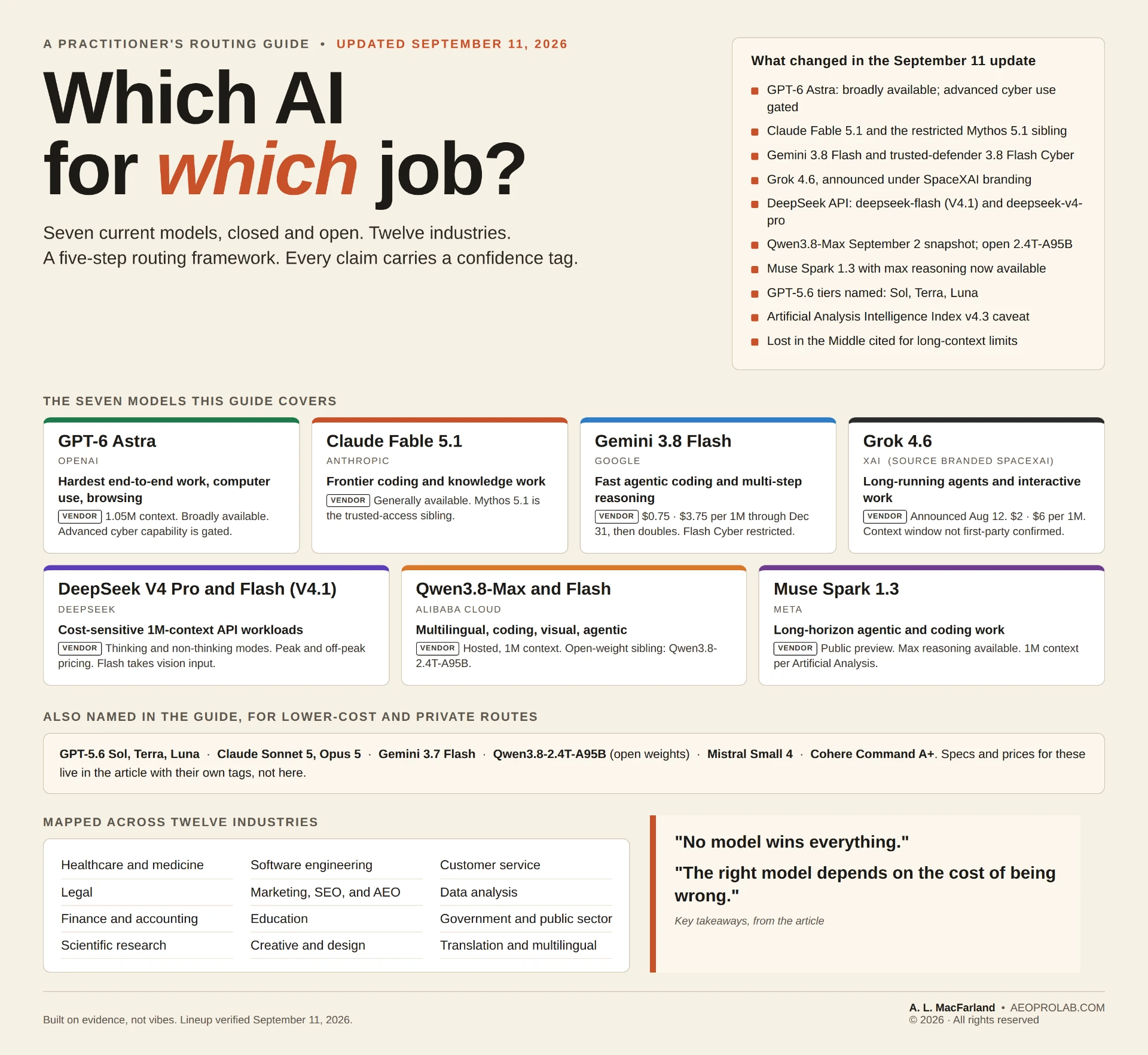
There is no single "best" AI model. As of September 11, 2026, the strongest current fits depend on the task, product surface, access tier, tools, governance requirements, and the cost of being wrong:
- Hardest end-to-end professional work, computer use, research, and coding: GPT-6 Astra is OpenAI's current frontier model, but rollout and higher-risk capabilities are access-controlled [Vendor]
- Frontier coding and knowledge work: Claude Fable 5.1 is Anthropic's most capable generally available model; Mythos 5.1 is the restricted-access sibling for selected cybersecurity and life-sciences work [Vendor]
- Fast agentic work, coding, and high-throughput reasoning: Gemini 3.8 Flash is Google's current Flash workhorse [Vendor]
- Long-running agents and interactive technical work: Grok 4.6 is the current xAI flagship, announced under SpaceXAI branding [Vendor]
- Cost-sensitive large-context API workloads: DeepSeek's current API models are
deepseek-flash(served by DeepSeek-V4.1-Flash) anddeepseek-v4-pro(V4-Pro-0813), both with 1M-token context and thinking and non-thinking modes [Vendor] - Chinese, multilingual, coding, and agentic workflows: Qwen3.8-Max and Qwen3.8-Flash are Alibaba Cloud's current hosted frontier routes; an open-weight Qwen3.8-2.4T-A95B variant is also available [Vendor]
- Open-weight or private deployment: Mistral Small 4, Cohere Command A+, and workload-specific open models remain strong candidates where infrastructure control matters [Vendor]
- Meta agentic and coding workflows: Muse Spark 1.3 is Meta's current public-preview model for long-horizon agentic and coding work [Vendor]
The right model for your work depends on the cost of being wrong, your data-governance constraints, the product surface, and the task category. This guide breaks each down with evidence tags rather than pretending one model dominates everything.
Evidence note. This guide separates independently visible benchmark results from vendor-reported claims, aggregator snapshots, and practitioner judgment. Benchmark figures appear only where the model version, source, and evaluation context are inspectable. Treat exact model rankings as time-sensitive; use them to narrow the candidate set, not to replace workload testing.
Quick reference: best-supported AI model fit by industry
| Industry | Best-supported current fit | Why |
|---|---|---|
| Healthcare and medicine | Claude Fable 5.1 / GPT-6 Astra | Strong frontier reasoning; high-stakes use still requires controlled infrastructure and expert review |
| Legal | Claude Fable 5.1 (drafting and reasoning) / GPT-6 Astra (complex workflow) | Strong knowledge-work capability; routing and verification matter more than brand |
| Finance and accounting | GPT-6 Astra / Claude Fable 5.1 | Complex spreadsheet, document, reasoning, and agentic workflows |
| Scientific research, physics, chemistry, biology | GPT-6 Astra / Claude Fable 5.1 | Both vendors position current frontier models for advanced scientific and professional work |
| Software engineering | GPT-6 Astra / Claude Fable 5.1 / Gemini 3.8 Flash | Current frontier coding and agentic candidates; test inside the actual coding surface |
| Marketing, content, SEO, and AEO | Claude Fable 5.1 (prose and review) / GPT-6 Astra or Gemini 3.8 Flash (analysis) | Strong drafting plus large-scale analysis; search-surface behavior still requires direct observation |
| Education | Claude Fable 5.1 / Gemini 3.8 Flash | Strong explanation and reasoning; use lower-cost tiers where frontier capability is unnecessary |
| Creative and design | Claude Fable 5.1 (writing) / provider-specific media models | General-purpose reasoning and dedicated media generation are separate routing decisions |
| Customer service | Lower-cost Claude, GPT-5.6, Gemini Flash, or Qwen routes | Routine interactions usually do not justify frontier pricing |
| Data analysis | GPT-6 Astra / Claude Fable 5.1 / Gemini 3.8 Flash | Strong coding, structured analysis, and tool-use candidates |
| Government and public sector | Approved Claude, GPT, or Google infrastructure; open-weight options where sovereignty requires it | Compliance and deployment architecture dominate the routing decision |
| Translation and multilingual | Qwen3.8 / Cohere Command A+ / Gemini 3.8 Flash | Strong multilingual and enterprise deployment options |
These are starting points, not prescriptions. Always run your own evaluation on your actual workflow before standardizing.
Key takeaways
- No model wins everything. Coding, reasoning, agentic work, multimodal tasks, computer use, cost-efficiency, and deployment control still have different leaders depending on how the workload is defined.
- The routing unit is no longer just the model. Model plus product surface, tools, retrieval, reasoning mode, access tier, permissions, and validation increasingly determine real performance.
- Access and safety configuration are now part of capability routing. OpenAI applies stronger controls to Astra's advanced cyber capability, Anthropic separates Fable 5.1 from trusted-access Mythos 5.1, and Google separates Gemini 3.8 Flash from trusted-defender Flash Cyber. These implementations are not equivalent, but the routing consequence is the same: model name alone no longer describes the usable system.
- Vendor-reported numbers are not the same as independently verified numbers. Several 2026 leadership claims still come from vendor release notes, system cards, or private evaluations.
- The right model depends on the cost of being wrong. Match capability to task stakes; the cheapest operating configuration that reliably clears the acceptance threshold is usually the better choice.
How to read this guide: confidence tags
Major model-selection claims in this article carry a confidence tag. The tags exist because "X model leads on Y" ranges from "verified on an independent leaderboard updated yesterday" to "the vendor said so in a release blog." Both often get cited the same way in AI guides. They should not be.
- [Primary], independent benchmark leaderboard, peer-reviewed paper, official license, or directly inspectable primary evidence.
- [Aggregator], multi-source aggregator such as Artificial Analysis or another benchmark tracker that combines primary and self-reported data with methodology disclosed.
- [Vendor], from the model lab's own release blog, model card, technical report, API documentation, or pricing page. Useful, but still self-reported.
- [Judgment], practitioner observation from real workflows. Useful, but not a measurement.
- [Insufficient], the claim is circulating, but public evidence is thin, stale, or not independently reproduced. Verify before betting on it.
Why there is no "best" AI model
There is the cheapest operating configuration that reliably clears the task you care about. Anyone selling you a one-line answer to "which AI should I use" is selling either a product or an opinion, usually both.
Every model has a capability ceiling and a price floor. But in 2026, that is only part of the equation. Product surface, retrieval, tools, access tier, reasoning effort, permissions, and validation all change what the system can actually do.
That math changes by task. A customer service chatbot does not need the same model and controls as a scientific research agent. A blog post draft does not carry the same cost of error as a legal, medical, financial, or security decision. The model you pick for one job is almost never the right operating configuration for every other job.
Common myths about AI models, answered
Is GPT-6 Astra, Claude Fable 5.1, or Gemini 3.8 Flash the best AI model overall?
None is. GPT-6 Astra is OpenAI's current frontier model for the hardest end-to-end work [Vendor]. Claude Fable 5.1 is Anthropic's most capable generally available model for coding and knowledge work [Vendor]. Gemini 3.8 Flash is Google's current high-speed workhorse for software engineering, agentic tasks, and complex multi-step reasoning [Vendor]. They are not identical products, and their surrounding tools, access tiers, and deployment surfaces differ. "Best overall" is the wrong question.
Has open-weight AI caught up to closed-source AI in 2026?
Partly. DeepSeek V4, Qwen3.8 open-weight variants, Mistral, and other open models are highly competitive for many production workloads [Vendor + Judgment]. But "caught up" is too broad. Frontier computer use, advanced agentic workflows, restricted high-risk capabilities, and some forms of professional reasoning still depend heavily on closed-model systems and their surrounding tools. Open-weight can be the better choice even when it is not the absolute capability leader because control, privacy, cost, and deployment flexibility matter.
Does a bigger context window mean better long-document recall?
No. Long-context performance can degrade when important information is buried deep in the prompt, a problem documented in long-context research [Primary]. Liu et al.'s Lost in the Middle found that models often perform best when relevant information appears near the beginning or end of a long context and worse when it appears in the middle: arxiv.org/abs/2307.03172. A 1M-token context window means the model can accept that amount of context. It does not prove reliable reasoning across every token. For large-document work, test retrieval, ordering, contradiction handling, and factual recall at the lengths you actually use.
Should I fine-tune a model to improve factual accuracy?
Usually not as the first move. Fine-tuning is useful for behavior, style, formatting, and specialized task adaptation. If the problem is current or proprietary knowledge, retrieval and source-grounding are often the more maintainable solution [Judgment]. The right answer depends on the failure mode you are trying to correct.
Do bigger models always perform better?
No. Smaller or faster models can outperform larger ones on narrow tasks, especially when the larger model is overkill or slower than the workflow tolerates. Post-training, reasoning configuration, tools, and domain fit matter. Parameter count alone is not a routing policy.
Do benchmark scores predict real-world performance?
Directionally, sometimes. Precisely, no. Benchmarks differ in contamination resistance, tool use, reasoning settings, scaffolding, retries, and evaluation methodology. Use them to narrow the candidate set, then test the top candidates on representative work from your own environment.
Are free or cheap AI models good enough?
For many things, yes, including routine drafting, summarization, classification, and low-stakes transformations [Judgment]. For high-impact decisions, the model cost is usually small compared with the cost of a bad output. Match model capability and validation effort to the consequence of error.
Do I need an open-weight model for data privacy?
Not necessarily. A closed model running through compliant enterprise infrastructure can be more appropriate than an open-weight model deployed badly. The license on the model is not the same thing as the security, privacy, retention, residency, or auditability of the deployment.
Will AI replace my profession?
Current systems increasingly automate parts of professional workflows, but accountability still matters [Judgment]. The practical question is not whether an entire profession disappears in one step. It is which tasks can be performed faster, cheaper, or more reliably with AI, which still require expert judgment, and which new failure modes appear when the system is given more autonomy.
What is each AI model best at?
What is Claude Fable 5.1 best for?
Claude Fable 5.1 is Anthropic's current generally available frontier model for coding and knowledge work. Anthropic says Fable 5.1 and Mythos 5.1 are the same underlying model with different safeguards; Fable is generally available while Mythos is restricted to trusted-access programs [Vendor].
Where evidence is strongest:
- Coding and knowledge work are the two categories Anthropic explicitly emphasizes for Fable 5.1 [Vendor]
- Fable 5.1 is generally available, while Mythos 5.1 is the restricted sibling for selected cybersecurity and life-sciences work [Vendor]
- Anthropic reports lower effective cost for many workloads than Fable 5 because cache-read pricing was reduced [Vendor]
- The model is designed for agentic and professional workflows where long-horizon reasoning matters [Vendor]
Where evidence is mixed or behind:
- Broad claims that Fable 5.1 is "best overall" remain vendor-positioning unless reproduced on independent benchmarks [Insufficient]
- Its higher capability does not make it the automatic cost default for routine tasks [Judgment]
- Mythos access, safeguards, retention, and policy conditions should not be generalized to Fable [Vendor]
What is GPT-6 Astra best for?
GPT-6 Astra is OpenAI's current frontier model for the hardest end-to-end work, including computer use, browsing, software engineering, cybersecurity, science, research, and professional workflows. Astra is now broadly available across supported API, ChatGPT Work, Codex, and eligible ChatGPT plans, although exact access still varies by plan, product surface, workspace controls, and region. The remaining restriction to emphasize is capability-scoped: advanced cyber behavior is more tightly controlled than ordinary Astra use [Vendor].
Where evidence is strongest:
- OpenAI explicitly positions Astra as its most capable model for hard end-to-end work [Vendor]
- The model supports a 1,050,000-token context window in the API [Vendor]
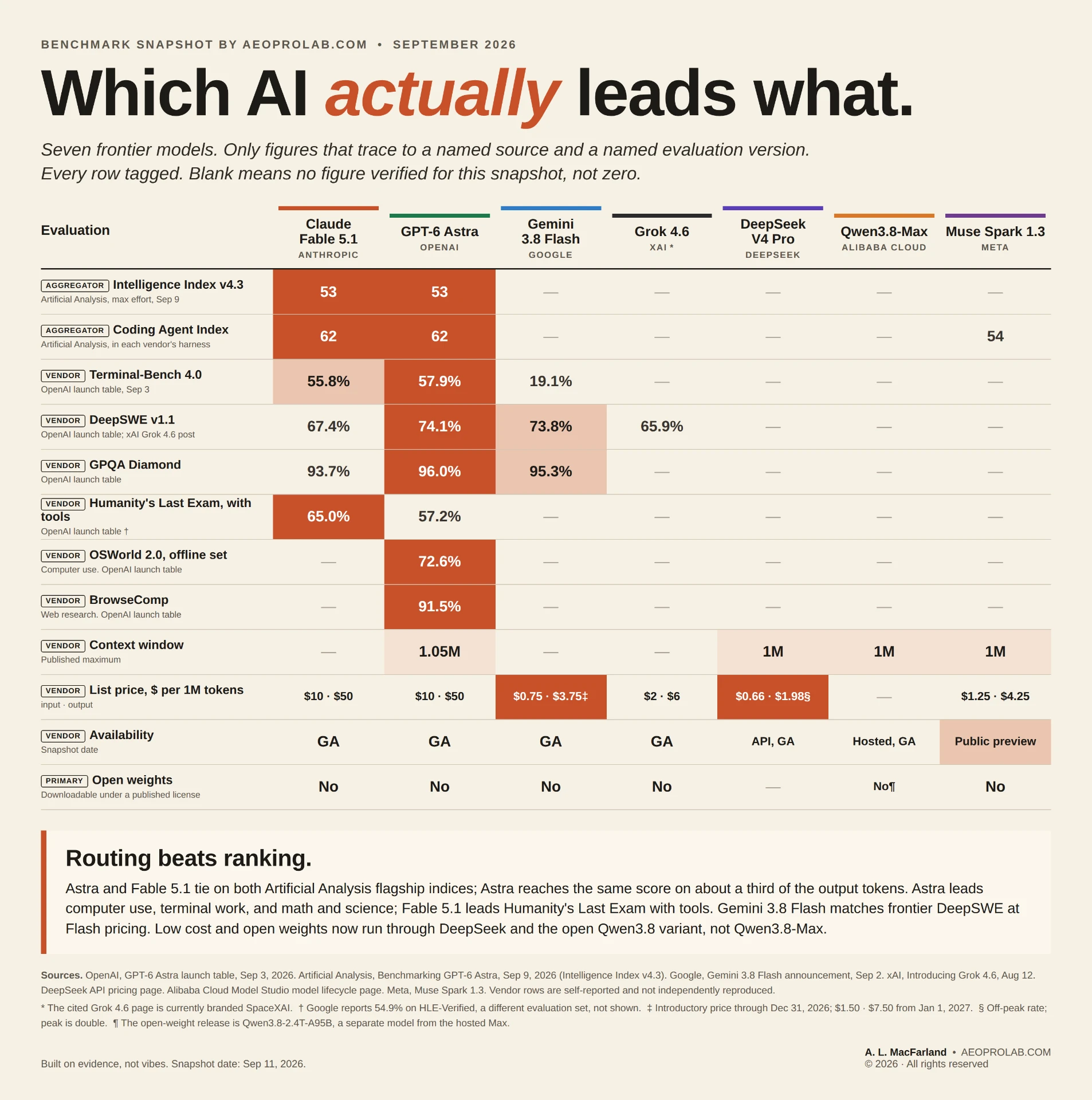
- OpenAI reports 72.6% on OSWorld 2.0 for Astra versus 65.7% for GPT-5.6 Sol, and 91.5% on BrowseComp versus 90.4% for Sol [Vendor]
- On Artificial Analysis Intelligence Index v4.3, GPT-6 Astra and Claude Fable 5.1 are tied at 53, with Astra at the lower cost of the two, while sub-benchmark strengths differ. The tie is specific to v4.3, which added evaluations and rescaled scores. On the earlier v4.1.1 index cited in OpenAI's own launch table, Fable 5.1 scored 65.7 and Astra 61.2, which is why most coverage from before the rescale still reports Fable 5.1 ahead [Aggregator]
- OpenAI classifies Astra at its Critical cybersecurity capability threshold and applies additional safeguards to advanced cyber use [Vendor]
Where evidence is mixed or behind:
- Many headline benchmark claims are vendor-reported and should not be treated as independent proof [Vendor]
- Access and refusal behavior are part of the product, especially for advanced cyber work [Vendor]
- GPT-5.6 can still be the better route when Astra's added capability does not justify the extra cost, latency, or access requirements [Judgment]
What is Gemini 3.8 Flash best for?
Gemini 3.8 Flash is Google's current Flash workhorse for fast reasoning, software engineering, agentic tasks, and complex multi-step workflows. Google released it September 2, only three weeks after 3.7 Flash. It is priced aggressively for this capability tier, but that introductory price is temporary [Vendor].
Where evidence is strongest:
- Google positions 3.8 Flash as its most intelligent workhorse model [Vendor]
- It is explicitly aimed at software engineering, autonomous agents, and complex enterprise workflows [Vendor]
- Google reports 54.9% on HLE-Verified for 3.8 Flash [Vendor]
- Introductory API pricing is $0.75 per million input tokens and $3.75 per million output tokens through December 31, 2026; standard pricing doubles to $1.50 and $7.50 on January 1, 2027 [Vendor]
- Gemini 3.8 Flash Cyber exists as a separate trusted-defender variant for specialized cybersecurity work [Vendor]
- Google explicitly keeps Gemini 3.7 Flash supported for efficiency-first workloads where 3.8's extra reasoning is unnecessary [Vendor]
Where evidence is mixed or behind:
- Gemini 3.8 Flash should not be treated as equivalent to Google Search, AI Mode, AI Overviews, or Maps [Primary + Judgment]
- The extremely fast release cadence makes static benchmark rankings age quickly [Judgment]
- Restricted Flash Cyber capability should not be generalized to public 3.8 Flash [Vendor]
What is Grok 4.6 best for?
Grok 4.6 is the current xAI flagship for long-running agents, coding, research, interactive work, and multi-step knowledge tasks. The model was announced in August 2026 on the x.ai announcement page, which brands the publisher as SpaceXAI rather than xAI; this guide uses "xAI" for continuity with the model's API and product naming and flags the branding change so the source is recognizable [Vendor].
Where evidence is strongest:
- xAI positions Grok 4.6 around long-running agentic and professional workflows [Vendor]
- Context-window size is not stated on the cited announcement page. Widely repeated 500K figures are not first-party confirmed here, so treat the working context limit as something to verify in the API documentation for your access tier [Insufficient]
- Reasoning configuration can be adjusted in supported environments [Vendor]
- Grok remains distinctive when used inside products that connect it to X or other xAI retrieval surfaces [Vendor]
Where evidence is mixed or behind:
- The base model is not the same thing as live X Search, web search, or external retrieval [Vendor]
- Independent verification remains thinner than for models with broader third-party benchmark coverage [Insufficient]
- Product behavior can differ materially across xAI API, Grok product surfaces, and third-party hosts [Judgment]
What is DeepSeek V4 best for?
DeepSeek V4 remains one of the strongest current price-performance candidates for large-context, coding, reasoning, and agentic API workloads. DeepSeek's first-party API currently exposes deepseek-flash, served by DeepSeek-V4.1-Flash, and deepseek-v4-pro, served by V4-Pro-0813 [Vendor]. deepseek-v4-flash is a legacy name: that model has been retired and requests to it are served by V4.1-Flash [Vendor]. Third-party hosted snapshots such as the Alibaba Model Studio listing of deepseek-v4-flash-0731 are not the same service as DeepSeek's own API and should not be quoted as first-party model availability [Judgment].
Where evidence is strongest:
- Both current API models support 1M-token context windows [Vendor]
- Both support thinking and non-thinking modes [Vendor]
- Both support JSON output, tool calls, Responses-style interfaces, and Anthropic-compatible API access [Vendor]
- Flash is substantially cheaper than many closed frontier models, while V4 Pro provides the higher-capability route [Vendor]
- DeepSeek publishes peak and off-peak pricing, so effective cost depends on when the workload runs [Vendor]
- Flash supports vision input; V4 Pro does not [Vendor]
- DeepSeek states that V4 Pro service continues past September 14 following a planned discontinuation, so check the pricing page before assuming a retirement date [Vendor]
- The old
deepseek-chatanddeepseek-reasoneraliases were retired in favor of explicit V4 model names [Vendor]
Where evidence is mixed or behind:
- Price-performance leadership depends on the actual workload, tool stack, retry rate, and human-review cost [Judgment]
- Hosted API availability and open-weight deployment should not be treated as the same thing [Judgment]
- Claims of parity with the newest closed frontier models should be verified task by task [Insufficient]
What is Qwen3.8 best for?
Qwen3.8 is one of the strongest current model families for multilingual, coding, visual, and agentic workflows, with both hosted and open-weight options. Alibaba Cloud's September 2 Qwen3.8-Max snapshot retains a 1M-token context window and emphasizes coding, long-horizon autonomous development, multi-tool orchestration, and visual understanding [Vendor].
Where evidence is strongest:
qwen3.8-maxandqwen3.8-flashare supported hosted models in Alibaba Cloud Model Studio [Vendor]- Qwen3.8-Max retains a 1M-token context window [Vendor]
- Alibaba positions the current Max line around complex engineering, long-horizon development, professional work, and multimodal reasoning [Vendor]
- Qwen3.8-2.4T-A95B is an open-weight flagship variant with a 1M context window [Vendor]
- The family provides a useful mix of hosted and open deployment choices [Vendor]
Where evidence is mixed or behind:
- Exact licensing and infrastructure requirements vary by model; do not transfer one Qwen model's terms to another [Primary]
- Vendor benchmark claims should be independently checked before calling Qwen the outright leader in a category [Insufficient]
- "Best for Asian languages" is plausible but should be tested on the actual languages, dialects, terminology, and production context [Judgment]
What is Meta Muse Spark 1.3 best for?
Muse Spark 1.3 is Meta's current public-preview model for long-horizon agentic workflows, coding, and multimodal work. Meta announced version 1.3 on September 2 and now lists its max reasoning configuration as available through Muse Code and the Meta Model API [Vendor].
Where evidence is strongest:
- Meta positions Muse Spark 1.3 for longer-horizon agentic workflows and coding [Vendor]
- It supports native multimodal work across text, images, video, and documents [Vendor]
- Artificial Analysis currently lists a 1M-token context window for both Muse Spark 1.3
maxandxhigh[Aggregator] - Meta's launch-week safety hold on
maxis no longer the current state; current Meta documentation saysmaxis available [Vendor]
Where evidence is mixed or behind:
- Performance changes materially with reasoning configuration, so benchmark claims must name
max,xhigh, or another effort level [Aggregator] - Artificial Analysis has shown Fable 5.1 ahead of Muse Spark 1.3 on its overall Intelligence Index, even though Muse is substantially cheaper per task. Index version matters here: Muse Spark 1.3's placement on the rescaled v4.3 index is not confirmed, so read this as a pre-v4.3 comparison until you check the current board [Aggregator + Insufficient]
- Public-preview status means availability and supported features can still change quickly [Vendor]
Best AI model by industry in 2026
The framing here is task-fit, not authority. The question is not "what should a hospital use." It is "given the constraints in healthcare, which current operating configurations are worth testing first, and what must be verified before deployment."
Best AI for healthcare and medicine
For healthcare workflows, Claude Fable 5.1 and GPT-6 Astra are strong frontier candidates, but model selection is secondary to controlled deployment, evidence grounding, and expert review.
Constraints that matter: HIPAA compliance, hallucination resistance, source traceability, access controls, retention, regulatory liability.
Best-supported current fits:
- For clinical note summarization and patient communication: Claude Fable 5.1 or a lower-cost validated Claude tier [Vendor + Judgment]
- For complex evidence synthesis and professional reasoning: GPT-6 Astra or Claude Fable 5.1 [Vendor]
- For multimodal document workflows: Gemini 3.8 Flash is worth testing where speed and tool integration matter [Vendor]
- For controlled private deployment: evaluate open-weight or private-cloud models against the exact privacy and performance requirement [Judgment]
Constraints to verify before deployment:
- Use infrastructure with the required contractual and regulatory controls. Consumer chat access is not a substitute for a compliant deployment.
- Do not infer clinical safety from a general benchmark.
- No model should make unreviewed clinical decisions.
Best AI for legal work
For legal work, Claude Fable 5.1 and GPT-6 Astra are the strongest current frontier candidates to test for complex drafting, document analysis, and multi-step workflows.
Constraints that matter: precision, citation reliability, confidentiality, document handling, auditability.
Best-supported current fits:
- For contract review and complex drafting: Claude Fable 5.1 [Vendor + Judgment]
- For tool-heavy legal workflow automation: GPT-6 Astra [Vendor]
- For high-throughput document analysis: Gemini 3.8 Flash or other validated long-context routes [Vendor]
- For private deployment: evaluate Cohere, Mistral, Qwen, or other appropriate private or open models against the exact requirement [Vendor + Judgment]
Constraints to verify before deployment:
- Verify every legal citation and authority manually.
- Use enterprise infrastructure with explicit data-isolation and retention guarantees for client work.
- Treat model output as work product requiring professional review, not legal authority.
Best AI for finance and accounting
For complex spreadsheet, document, and analytical workflows, GPT-6 Astra and Claude Fable 5.1 are the strongest current frontier candidates to test.
Constraints that matter: numerical precision, structured output, spreadsheet operability, traceability, audit trails.
Best-supported current fits:
- For computer- and spreadsheet-heavy workflows: GPT-6 Astra [Vendor]
- For financial modeling, analysis, and narrative explanation: Claude Fable 5.1 [Vendor + Judgment]
- For fast document-heavy analysis: Gemini 3.8 Flash [Vendor]
- For high-volume lower-cost processing: GPT-5.6 Luna, Claude Sonnet 5, DeepSeek Flash (V4.1-Flash), Qwen3.8-Flash, or another validated efficient tier [Vendor]
Constraints to verify before deployment:
- Expert review for regulated advice or material financial decisions.
- Test arithmetic, spreadsheet edits, and tool actions, not just prose.
- Match audit-trail requirements to the deployment environment.
Best AI for scientific research, physics, chemistry, and biology
For advanced scientific work, GPT-6 Astra and Claude Fable 5.1 are the strongest current frontier candidates to test, while specialized access programs may expose additional capabilities under stricter controls.
Constraints that matter: correctness on hard reasoning, source quality, mathematics, domain specialization, multimodal interpretation, dual-use risk.
Best-supported current fits:
- For difficult scientific reasoning and professional research: GPT-6 Astra [Vendor]
- For knowledge work and research synthesis: Claude Fable 5.1 [Vendor]
- For restricted higher-risk biology research: Claude Mythos 5.1 only where the organization qualifies and the use is permitted [Vendor]
- For fast multimodal analysis and long-context technical material: Gemini 3.8 Flash [Vendor]
Reality check. Vendor benchmark breakthroughs are useful signals, but publication-grade scientific conclusions still require expert validation, source inspection, and reproducibility.
Best AI for software engineering
For production coding and agentic software work, GPT-6 Astra, Claude Fable 5.1, and Gemini 3.8 Flash are the leading current candidates to test. Grok 4.6 and Muse Spark 1.3 are also relevant depending on the coding environment.
Constraints that matter: code quality, repository comprehension, tool integration, terminal proficiency, test execution, rollback, recovery.
Best-supported current fits:
- For hard end-to-end software work: GPT-6 Astra [Vendor]
- For coding and long-horizon knowledge work: Claude Fable 5.1 [Vendor]
- For fast agentic coding: Gemini 3.8 Flash [Vendor]
- For long-running coding agents: Grok 4.6 and Muse Spark 1.3 are worth direct evaluation [Vendor]
- For cost-sensitive coding at scale: DeepSeek V4 Pro and DeepSeek Flash (V4.1-Flash) and Qwen3.8 [Vendor]
Constraints to verify before deployment:
- The coding surface matters as much as the base model.
- Test repository access, tools, permissions, unit tests, rollback, and recovery.
- Do not infer production reliability from one coding leaderboard.
Best AI for marketing, content, SEO, and AEO
For long-form writing and nuanced review, Claude Fable 5.1 is a strong current candidate. For larger analytical and tool-driven workflows, GPT-6 Astra and Gemini 3.8 Flash deserve testing.
Constraints that matter: prose quality, factual reliability, brand voice, evidence handling, retrieval, source citation, search-surface observation.
Best-supported current fits:
- For long-form content and editorial review: Claude Fable 5.1 [Vendor + Judgment]
- For structured analysis, tooling, and complex workflow execution: GPT-6 Astra [Vendor]
- For fast large-scale analysis: Gemini 3.8 Flash [Vendor]
- For high-volume production: GPT-5.6 Luna is OpenAI's lowest-cost 5.6 tier, while GPT-5.6 Terra is the balanced middle tier; Claude Sonnet 5, Gemini Flash, Qwen3.8-Flash, DeepSeek Flash (V4.1-Flash), and Mistral routes may also be economically better than frontier defaults [Vendor + Judgment]
Constraints to verify before deployment:
- For AEO specifically, post-generation verification matters more than the generation model.
- A chatbot response is evidence of that chatbot response, not proof of how Google Search, AI Overviews, AI Mode, Maps, ChatGPT Search, Perplexity, or another proprietary surface behaves.
- The measurement may be legitimate while the recommendation built on top of it is not yet established.
Best AI for education
For tutoring, explanation, and curriculum-support workflows, Claude Fable 5.1 and Gemini 3.8 Flash are strong current candidates, with lower-cost models often sufficient for routine tasks.
Constraints that matter: clear explanation, age-appropriate framing, factual accuracy, hallucination control, privacy.
Best-supported current fits:
- For complex tutoring and explanation generation: Claude Fable 5.1 [Vendor + Judgment]
- For fast multimodal educational work: Gemini 3.8 Flash [Vendor]
- For multilingual education: Qwen3.8 and Cohere Command A+ are worth testing [Vendor]
- For automated grading or classification: use a lower-cost model that passes a held-out evaluation set [Judgment]
Best AI for creative work and design
For writing-heavy creative work, Claude Fable 5.1 is a strong current candidate. For image, audio, and video generation, dedicated media models should be evaluated separately from general-purpose LLMs.
Constraints that matter: voice, originality, iteration speed, multimodal inputs, output rights, production workflow.
Best-supported current fits:
- For copywriting and long-form creative development: Claude Fable 5.1 [Judgment]
- For structured ideation and document creation: GPT-6 Astra [Vendor]
- For multimodal interpretation: Gemini 3.8 Flash and Muse Spark 1.3 [Vendor]
- For image, video, and audio generation: use the provider-specific media model best suited to the aesthetic and production requirement [Judgment]
Best AI for customer service and operations
For high-volume customer-service workloads, the best answer is usually not the frontier model. Use the lowest-cost model that reliably meets quality, latency, escalation, and safety requirements.
Constraints that matter: cost per interaction, latency, consistency, tool reliability, escalation handling.
Best-supported current fits:
- For routine customer-service interactions: Claude Sonnet 5, GPT-5.6 Luna, Gemini 3.7 or 3.8 Flash, Qwen3.8-Flash, or DeepSeek Flash (V4.1-Flash), depending on the quality threshold and tool requirements [Vendor + Judgment]
- For more complex escalations: route selectively to Claude Fable 5.1, GPT-6 Astra, or another frontier model [Vendor + Judgment]
- For self-hosted or sovereignty-sensitive operations: evaluate Mistral, Qwen, DeepSeek, or Cohere depending on infrastructure requirements [Vendor]
Reality check. Frontier models often make poor economic defaults for repetitive high-volume work. Measure cost per resolved or accepted interaction, not cost per token alone.
Best AI for data analysis
For tool-heavy analytical workflows, GPT-6 Astra, Claude Fable 5.1, and Gemini 3.8 Flash are the strongest current candidates to test.
Constraints that matter: code generation, statistical reasoning, source fidelity, structured output, execution environment.
Best-supported current fits:
- For computer-use and integrated analytical workflows: GPT-6 Astra [Vendor]
- For SQL, code, and complex analytical explanation: Claude Fable 5.1 [Vendor + Judgment]
- For fast multimodal and long-context analysis: Gemini 3.8 Flash [Vendor]
- For cost-sensitive batch analysis: DeepSeek V4 or Qwen3.8 [Vendor]
Best AI for government and public sector
For government work, model choice should follow approved infrastructure, data classification, residency, auditability, and procurement requirements rather than public leaderboard position.
Constraints that matter: data sovereignty, FedRAMP or equivalent authorization, auditability, retention, access control, regional regulations.
Best-supported current fits:
- US federal: use only models and cloud environments approved for the workload's authorization level [Primary + Vendor]
- State and local: evaluate compliant closed infrastructure and private or open deployment routes according to residency requirements [Judgment]
- Sovereignty-sensitive deployments: evaluate Mistral, Cohere, Qwen, DeepSeek, or other appropriate open or private models where licensing and infrastructure permit [Vendor]
Best AI for translation and multilingual content
For multilingual production, Qwen3.8, Cohere Command A+, Gemini 3.8 Flash, and other frontier multilingual models are all worth testing by language rather than assuming one global winner.
Constraints that matter: language coverage, dialect, cultural appropriateness, domain terminology, formatting, deployment geography.
Best-supported current fits:
- For Chinese and Asian-language production: Qwen3.8 is a strong candidate [Vendor + Judgment]
- For enterprise multilingual work: Cohere Command A+ is positioned for broad multilingual enterprise use. A specific supported-language count is not confirmed here, so check Cohere's current model documentation for the exact list before committing to a language [Insufficient]
- For broad multimodal multilingual workflows: Gemini 3.8 Flash [Vendor]
- For high-stakes translation: pair any model with explicit human verification and terminology controls [Judgment]
How to choose the right AI model: a 5-step framework
Step 1: identify the cost of being wrong. A blog post draft with a typo is cheap to correct. A bad medical, legal, financial, or security decision can be expensive or dangerous. The cost of being wrong determines the capability and validation you need.
Step 2: match capability to that cost. If the consequence of failure is high, use a stronger model, tighter evidence requirements, and mandatory review. If the consequence is low, use the cheapest route that reliably clears your acceptance threshold.
Step 3: check the constraint stack. Data sovereignty? Access tier? Retention? Compliance? Tool permissions? Latency? Very high volume? These constraints can change the answer before benchmark performance does.
Step 4: run a real test. Benchmark differences do not automatically translate into workflow differences. Test the top candidates on actual tasks from your environment, with the real tools, documents, permissions, and acceptance criteria.
Step 5: plan for routing, not picking. Mature deployments increasingly route different jobs to different models and surfaces. Routine work may go to a fast low-cost model, complex work to a frontier model, sensitive work to a restricted or private deployment, and high-impact outputs to mandatory human review.
Frequently asked questions
What is the best AI model in 2026?
There is no single best AI model in 2026. GPT-6 Astra, Claude Fable 5.1, Gemini 3.8 Flash, Grok 4.6, DeepSeek V4, Qwen3.8, Muse Spark 1.3, Mistral, Cohere, and other models each make sense under different workloads and constraints. The right choice depends on the job, product surface, access tier, tools, data requirements, latency, cost, and consequence of error.
Is Claude better than ChatGPT for coding?
Sometimes. Claude Fable 5.1 is Anthropic's current frontier model for coding and knowledge work [Vendor]. GPT-6 Astra is OpenAI's current frontier model for hard end-to-end work including software engineering [Vendor]. The better coding system depends on the coding surface, repository access, tool execution, test harness, permissions, and recovery design. Test both on your actual repositories rather than relying on a single leaderboard.
Should I use ChatGPT or Claude for medical work?
Neither should be treated as a medical authority. GPT-6 Astra and Claude Fable 5.1 are strong frontier candidates for evidence synthesis and professional work, but patient data requires appropriate infrastructure and medical decisions require expert review. Deployment controls matter as much as the model.
What is the cheapest AI model with frontier-level performance?
There is no durable single answer because pricing and model capability change quickly. Within OpenAI's 5.6 family, Luna is the lowest-cost tier at $0.20 and $1.20 per million input and output tokens, while Terra is the balanced tier at $2 and $12 [Vendor]. Claude Sonnet 5 has been listed at $2 and $10, described in at least one source as an introductory rate against a $3 and $15 standard price. Which of the two is current is not confirmed here, so price the workload from Anthropic's pricing page before budgeting [Vendor + Insufficient]. DeepSeek V4 and Qwen3.8 remain aggressive price-performance candidates in current API and hosted markets [Vendor]. The meaningful metric is still cost per accepted result after retries, tools, retrieval, and human review.
Is DeepSeek V4 actually as good as Claude Fable 5.1 or GPT-6 Astra?
On some workloads it may be competitive; on others it will not be. DeepSeek V4 offers 1M context, tool use, thinking modes, and very low API pricing [Vendor]. That does not establish parity with the newest frontier models on every reasoning, computer-use, coding, or agentic task. Test the exact workload.
Is open-source AI as good as closed-source AI?
It depends on the task. Open-weight models can be excellent for coding, summarization, classification, multilingual work, and private deployment. Closed frontier models still lead or differentiate on some high-end agentic, computer-use, multimodal, and restricted-capability workflows. Deployment control can make an open model the better business choice even when a closed model scores higher.
What AI model has the largest context window?
Published context-window size changes rapidly and should not be confused with dependable long-context reasoning. Several current models support roughly 1M-token contexts, including GPT-6 Astra at 1.05M, current DeepSeek V4 and Qwen3.8 routes at 1M, Gemini 3.8 Flash at 1M, and Muse Spark 1.3 at 1M according to Artificial Analysis [Vendor + Aggregator]. The practical question is how reliably each configuration performs at the context lengths you actually use.
Which AI model hallucinates the least?
There is no single stable answer that should be treated as universal. Hallucination rate varies by task, retrieval, prompt, model version, and evaluation. For high-stakes work, source grounding, contradiction checks, citation auditing, and human review matter more than relying on a global "least hallucination" label.
What is the difference between SWE-bench Verified and SWE-bench Pro?
SWE-bench Verified is a human-validated subset of real GitHub issues used to test software-engineering agents. SWE-bench Pro is designed to be harder and more resistant to contamination and includes broader task coverage. Scores from different harnesses, tool configurations, model versions, and reasoning settings should not be compared casually.
How often do AI benchmark leaderboards change?
Frequently. Major model releases can change benchmark rankings in days, and vendors now ship substantial model updates within weeks of one another. Google released three Flash generations in six weeks during July to September 2026. Treat a static "best model" article as a dated snapshot and keep the routing framework separate from the lineup.
Glossary: AI benchmarks explained
- SWE-bench Verified, a human-validated subset of real GitHub issues testing whether models or agents can resolve software-engineering tasks.
- SWE-bench Pro, a harder software-engineering evaluation intended to reduce contamination and broaden task difficulty. Compare exact harness and model configurations before interpreting score differences.
- GPQA Diamond, graduate-level science questions in biology, physics, and chemistry. Useful for difficult reasoning comparisons but not a substitute for domain-specific evaluation.
- AIME, competition mathematics problems often used to test advanced mathematical reasoning. Frontier performance can saturate quickly, reducing its usefulness for separating top models.
- HLE (Humanity's Last Exam), a broad expert-level benchmark spanning multiple academic fields. Useful as one signal of difficult reasoning, but still sensitive to model version and evaluation configuration.
- OSWorld-Verified, benchmark for desktop computer-use tasks in real software environments. Tool configuration and agent scaffolding are part of the result.
- MCP-Atlas, a benchmark focused on tool use through the Model Context Protocol. Vendor-published results should be distinguished from independently reproduced results.
- LMArena, crowdsourced human-preference benchmark where users blind-vote between model responses. Preference ranking is useful but does not directly measure factuality, coding reliability, or tool performance.
- ARC-AGI, abstract-reasoning benchmark designed to test generalization on novel tasks. Version and evaluation conditions matter when comparing claims.
- BrowseComp, web research and synthesis benchmark. Performance depends on browsing and retrieval setup, not only the base model.
- Terminal-Bench, terminal and command-line agent benchmark covering shell automation and multi-step tool workflows.
- FrontierMath, hard mathematical reasoning benchmark designed to remain difficult for frontier systems.
- Artificial Analysis Intelligence Index, composite benchmark index. Useful for broad comparison, but inspect the underlying benchmark mix before applying it to a specific production job.
Sources and methodology
This guide synthesizes data from:
- Primary sources and leaderboards: SWE-bench, LMArena, Scale AI evaluations, benchmark papers, official model licenses, and directly inspectable benchmark documentation
- Aggregators: Artificial Analysis and other benchmark aggregators where methodology and source provenance are visible
- Vendor documentation: OpenAI, Anthropic, Google, xAI, DeepSeek, Alibaba and Qwen, Meta, Cohere, Mistral, Apple, and other model-provider release notes, API docs, model cards, pricing pages, and system cards
- Practitioner judgment: production observations used only where labeled [Judgment]
Current model-lineup verification for this September update used first-party documentation including:
- OpenAI, GPT-6 Astra release notes, model page, and safety overview: release notes, model page, safety overview
- Anthropic, Claude Fable 5.1 and Mythos 5.1 announcement and system cards: announcement, system cards
- Google, Gemini 3.8 Flash and Gemini 3.8 Flash Cyber: announcement
- xAI, Grok 4.6: announcement
- DeepSeek, API model and pricing documentation: API docs, pricing
- Alibaba Cloud Model Studio, Qwen3.8 model lifecycle and documentation: newly released models
- Meta, Muse Spark 1.3 and Meta Model API: announcement
- Artificial Analysis, current GPT-6 Astra, Claude Fable 5.1, and Muse Spark 1.3 comparisons: benchmarking article, model comparisons
- Liu et al., Lost in the Middle: How Language Models Use Long Contexts: arxiv.org/abs/2307.03172
Confidence tags ([Primary] / [Aggregator] / [Vendor] / [Judgment] / [Insufficient]) indicate the strength of the underlying proof for each claim.
Model lineup verified September 11, 2026.
The AI landscape now changes in weeks, not quarters. Treat model names, prices, benchmark numbers, and access rules as dated snapshots. Re-run the routing decision when any of those inputs changes.
Have a correction or pushback on a specific claim? Send it through the About page or by message on LinkedIn, and include the model, claim, source, and date you think should change. That is the point of confidence tags. Disagreement should be about evidence, not vibes.