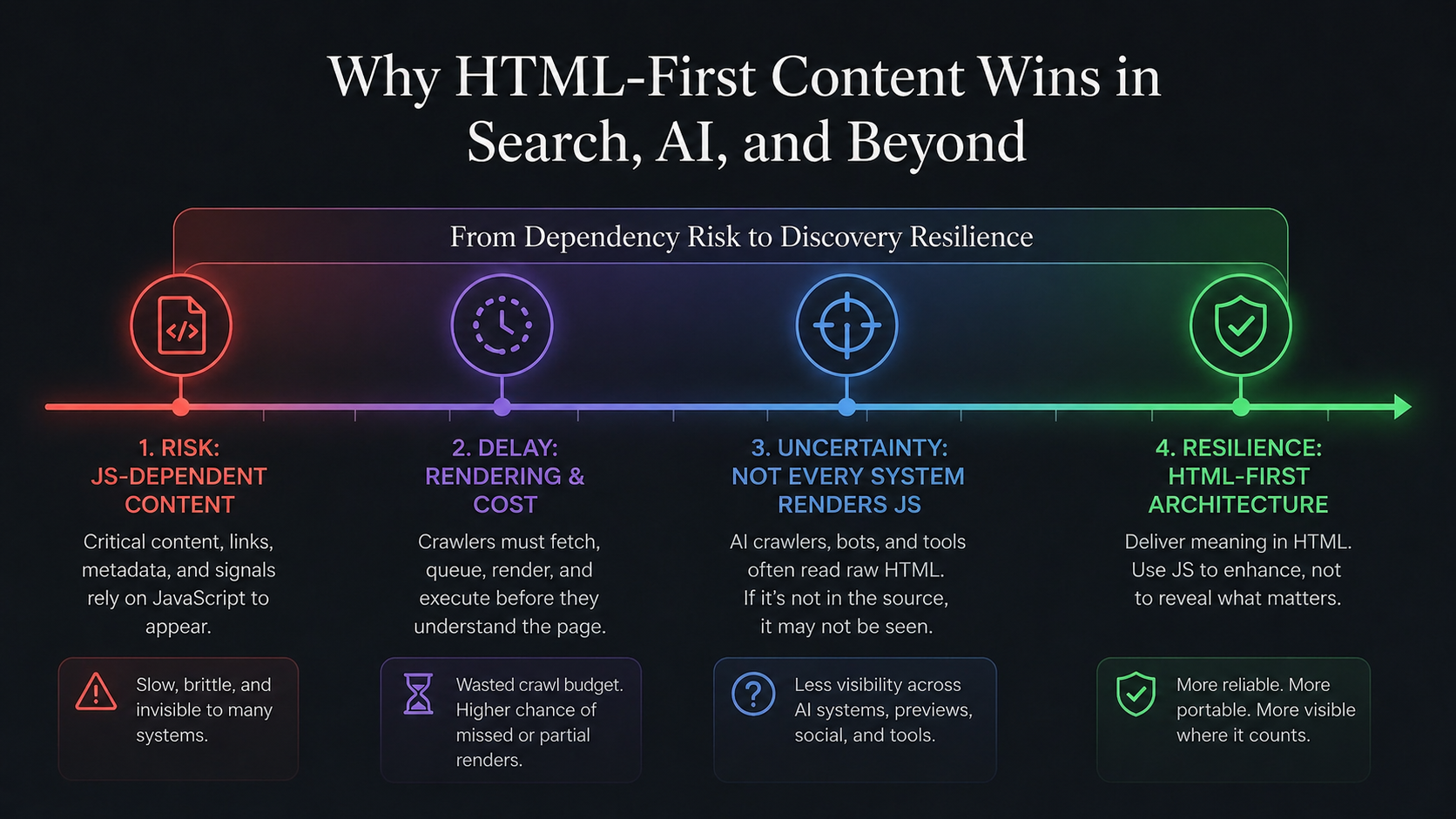
For years, JavaScript SEO had the wrong frame.
One side said JavaScript was bad for SEO. The other side said Google can render JavaScript, so the concern was outdated.
Both answers are too simple.
Google is highly capable of processing JavaScript. Its documentation describes a crawl, render, and index pipeline for JavaScript-powered pages. In March 2026, Google removed an outdated accessibility section from its JavaScript SEO basics documentation and stated that using JavaScript to load content is not making it harder for Google Search.
That is one of Google’s clearest recent signals on the topic.
The Google rendering question has matured. The wider discovery question has not.
A page that needs JavaScript to reveal its meaning still creates cost, delay, and failure risk. At scale, that can affect crawl efficiency. On fragile builds, it can affect what gets rendered. Outside Google, the risk gets sharper.
The better question is not: Can Google render this?
The better question is: Can every important discovery system understand this page without needing a perfect browser-level JavaScript session?
That is where many modern websites are fragile.
Google is capable, but JavaScript still has a cost
Google can process JavaScript, but it still happens through a process. Googlebot crawls the URL, processes the initial response, queues eligible pages for rendering, renders them, and then uses the rendered HTML for indexing and link extraction.
Compared with clean HTML, server-rendered output, or static output, JavaScript can still introduce:
- - rendering delay
- - crawl inefficiency on large sites
- - dependency on script availability
- - JavaScript error risk
- - metadata conflicts between source and rendered HTML
- - slower user experience
- - more complex debugging
The stronger position is this: Google has strong JavaScript rendering competency, but JavaScript still adds operational risk when important content depends on it.
Critical failures: why canonicals and noindex should not depend on JavaScript
Google clarified two important JavaScript SEO failure modes.
First, canonicalization happens before and after rendering. JavaScript pages should keep the canonical URL identical in both the source HTML and the rendered HTML, or omit it from the source HTML if matching cannot be guaranteed.
Second, if Googlebot encounters noindex in the initial HTML, it may skip rendering, meaning JavaScript that later removes the directive may never execute.
Do not make canonical truth depend on runtime correction.
Google is not the whole discovery environment
Search visibility is no longer limited to traditional search interfaces.
Content is now fetched, previewed, summarized, cited, embedded, compared, extracted, and reused across many systems.
These systems include:
- - Google Search
- - Bing
- - AI answer systems
- - live retrieval tools
- - LLM training crawlers
- - social preview bots
- - browser assistants
- - enterprise knowledge tools
- - SEO crawlers
- - partner scrapers
- - citation systems
- - summarization layers
They do not all behave like Googlebot.
Some render JavaScript. Some do not. Some fetch raw HTML. Some extract metadata only. Some operate with strict timeouts. Some are built for speed and cost efficiency, not full browser rendering.
Independent testing has reported that major AI crawlers such as GPTBot, ClaudeBot, and PerplexityBot did not execute client-side JavaScript in tested scenarios.
That should be treated as third-party testing rather than official behavior documentation for every platform, but the practical warning is clear:
A page can be acceptable for Google and still be weak across other discovery surfaces.
This is the modern blind spot.
HTML carries meaning more reliably than runtime JavaScript
HTML is declarative. It tells a machine what exists.
JavaScript is procedural. It tells a browser what to do to create, modify, or reveal what exists.
That difference matters.
A crawler, AI retrieval agent, social preview bot, or summarizer can inspect HTML immediately. It does not need to wait for scripts, hydration, API calls, device conditions, user interaction, or third-party resources.
HTML is often more reliable for machine discovery because it is stable, inspectable, and available at fetch time.
AI discovery is not one system
Training crawlers
Training crawlers collect web data at scale. Full JavaScript rendering across massive URL sets is expensive, so JavaScript-dependent content may be harder to ingest.
Live retrieval systems
Live retrieval systems fetch pages to answer current questions. Some may use headless browsers. Others may rely on raw HTML for speed, cost, or timeout reasons.
Social preview bots
Social preview bots commonly depend on server-visible metadata such as Open Graph tags, titles, descriptions, and preview images. If those are injected late through JavaScript, previews can fail or appear weak.
SEO tools and secondary crawlers
Some render JavaScript well. Some require rendering to be enabled. Some lightweight tools extract only raw HTML.
The practical takeaway is simple: If the page’s meaning requires JavaScript, the page becomes less portable across discovery systems.
Core Web Vitals are part of the same risk
Google’s published good thresholds are:
- - LCP: 2.5 seconds or less
- - INP: 200 milliseconds or less
- - CLS: 0.1 or less
JavaScript often affects all three.
Heavy JavaScript can delay the main content and hurt LCP. Large bundles can block interaction and hurt INP. Late widgets can shift layouts and hurt CLS.
Poor LCP or INP can also signal a heavy, expensive page experience. Resource-constrained bots and extraction systems are more likely to struggle with pages that are slow, unstable, or dependent on long execution chains.
The safest model: clear first, interactive second
HTML or server-rendered output should establish meaning. JavaScript should enhance experience.
Use HTML first for:
- - page title
- - H1
- - main content
- - entity identity
- - service, product, or location facts
- - internal links
- - canonical
- - structured data
- - CTA
Use JavaScript for:
- - filters
- - sort menus
- - forms
- - calculators
- - maps
- - personalization
- - chat
- - enhanced UI states
Ecommerce example
A fragile category page may load an empty app shell first, with category copy, products, and links only appearing after JavaScript runs.
Google may render it. Other systems may only see an empty shell.
A stronger version delivers category meaning, internal links, and featured products in HTML first, then uses JavaScript for filters and sorting.
Local service example
A fragile local page may depend on JavaScript to inject emergency service copy, service areas, phone number, reviews, financing, and the estimate CTA.
That places too much of the page’s meaning behind JavaScript execution.
A stronger version loads the service offer, local relevance, contact path, and trust signals immediately in HTML, then uses JavaScript for booking tools or chat.
Enterprise strategies that avoid the dependency risk
- - Server-side rendering for product and category pages
- - Static generation for articles and evergreen content
- - Incremental regeneration for large catalogs
- - Edge rendering for global speed improvements
- - Feed-based distribution for products, inventory, and locations
- - Controlled HTML snapshots where needed as a temporary bridge
Local strategies that avoid the dependency risk
Most local businesses do not need heavy JavaScript to win visibility.
They need:
- - clear service identity
- - crawlable location pages
- - trust signals in HTML
- - accurate business listings
- - visible contact paths
- - fast mobile usability
What teams can usually get away with
- - JavaScript filters if crawlable URLs exist
- - accordions if content exists in HTML
- - interactive tools with explanatory content
- - forms if the offer is visible first
- - maps with written address or service area
- - review widgets with fallback trust copy
- - personalization after core content loads
- - animation without layout shift
What teams should not rely on JavaScript alone to deliver
- - canonicals
- - noindex directives
- - hreflang
- - Open Graph tags
- - main content
- - internal links
- - product links
- - location facts
- - pricing
- - reviews
- - availability
- - 404 handling
- - primary CTAs
These are discovery infrastructure.
The clean approval question
If JavaScript fails, what truth about this page disappears?
If nothing important disappears, the implementation is probably fine.
If the offer, links, product, location, trust signals, metadata, or contact path disappear, the implementation is risky.
Final position
Google’s documented JavaScript rendering capability appears more mature than that of many other discovery systems.
That does not mean your page should depend on JavaScript to prove what it is.
HTML for meaning. JavaScript for experience. Feeds for structured distribution. Performance data for operational proof.
That is how serious teams avoid the problem instead of debating it forever.