| Task | Best Approach | Why | Risk |
|---|---|---|---|
| Prepare for agent selection | Invest in entity stability: consistent name, schema, knowledge graph presence, and sameAs relationships | Agents resolve tasks through entity identifiers; fragmented identity is a resolution failure | Brands with inconsistent identity across platforms become unselectable by automated agents |
| Separate authoritative from informational content | Add provenance, version control, and attestation to pricing, terms, availability, and policy pages | Agents need to distinguish content they can act on from content that merely informs | Agents that cannot verify authority will either skip the brand or act on stale data |
| Build dual readiness | Maintain both model-context presence (long-term) and real-time retrieval readiness (operational) | Being strong in one and absent in the other leaves the brand half-prepared | Brands that only optimize for one layer lose ground as the other becomes critical |
| Option | When to Use | Strength | Limitation |
|---|---|---|---|
| Traditional SEO | Markets still driven by search result pages | Proven playbook with established tools | Does not address agent-driven selection or action-layer readiness |
| AEO / GEO / LLMO | Current AI-mediated search environments | Addresses citation and summary-layer visibility | Focuses on retrieval, not on whether agents can act on the content |
| Agentic readiness | Preparing for AI systems that select and execute | Addresses the next structural shift before it arrives | Timeline is uncertain; no standard measurement framework yet |
| Entity stability investment | Any brand with fragmented identity across platforms | Compounds over time and benefits all visibility layers | Slow to show returns; hard to prioritize against short-term campaigns |
For most of the last twenty-five years, getting found has had different names: SEO for search engines, AEO for answer engines, GEO for generative engines, LLMO for model-level visibility.
The labels changed, but the assumption stayed mostly intact.
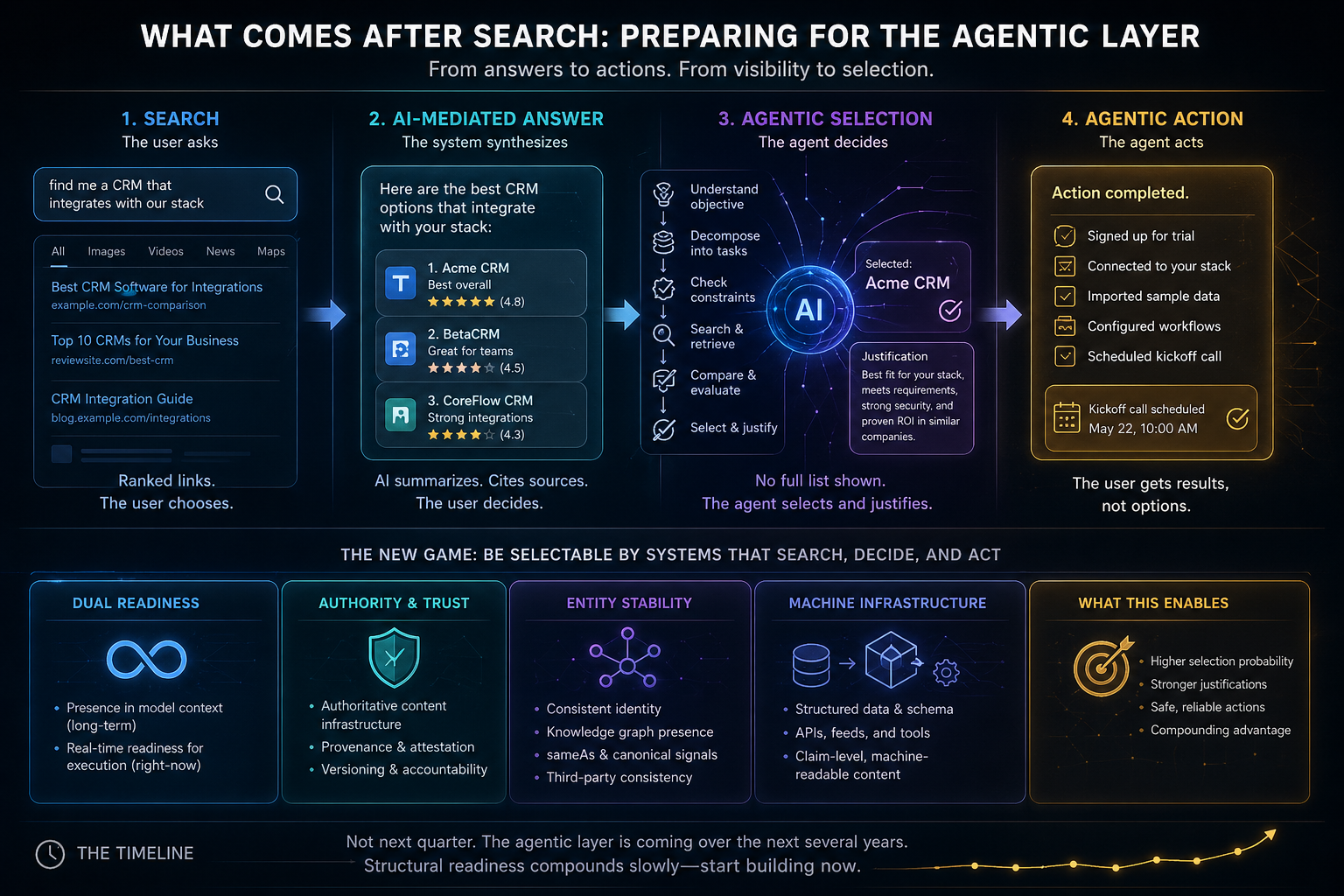
A user asks. A system retrieves. A surface presents. The user chooses.
Every version of the discipline has been about being well-positioned somewhere in that pipeline.
That assumption is starting to break.
In a LinkedIn article published before AI Overviews became a mainstream SEO concern, I argued that modern SEO needed creative risk-takers, not data hoarders. The point was not that data stopped mattering. It was that the next phase of search would reward people who could connect data, creativity, experimentation, and judgment before the market had a clean dashboard for it.
That shift is now visible.
Google's AI Overviews turned search from a list of links into a synthesis layer. The system does not merely retrieve pages. It summarizes, selects, and frames information before the user clicks.
AEO, GEO, and LLMO may prove to be the middle step.
What follows is the agentic layer.
In the agentic layer, the user-facing surface starts to shrink. The discipline is not only about being retrieved anymore. It is about being selected by a system that may not show the full field to a human at all.
From Query to Execution
Today's AI search still resembles human search.
A user asks. The AI retrieves. The AI summarizes. The AI cites. The user reads.
That is a translation layer.
The structural change comes when the AI stops only answering and starts acting.
In the mature version of this layer, a user who says, "Find me a CRM that integrates with our stack," does not get a comparison page. They get a selected CRM, a trial or contract workflow, configured integrations, and a kickoff call already placed on the calendar.
The agent did not show ten options.
It selected one, justified the choice if asked, and moved on.
A homeowner who searches for a plumber today gets local results, reviews, and phone numbers. Tomorrow's agent may return a confirmed appointment with a licensed, insured plumber whose pricing falls inside the agent's understanding of a fair range and whose availability matches the homeowner's calendar.
The list never appeared.
Brands in that environment do not compete only to be ranked, cited, or summarized.
They compete to be selectable inside agent toolchains.
That is a different game.
Three Things Change Immediately
The query weakens as the addressable unit
There may be no visible "search term" the brand can optimize around because the agent is not simply typing one. It is interpreting an objective, decomposing it into sub-tasks, checking constraints, invoking tools, comparing options, and resolving a decision.
Selection happens before the user sees the field
By the time anything visible reaches the user, the agent has already filtered. A brand that only competes at the visible-result layer may already be competing after the real decision has narrowed.
Justification replaces ranking
When users ask, "Why this one?" the agent's answer has to be structured, attributable, and defensible. Brands that give the system clean evidence, clear claims, stable entity signals, and current authoritative data have more material for that justification.
They do not just win the query.
They help the agent defend the choice.
The Collapse of Ranking as the Main Scoreboard
Global ranking does not disappear overnight.
But it becomes less useful as the primary measurement frame.
If users increasingly rely on personalized agents with different contexts, preferences, histories, budgets, calendars, permissions, and tool access, then the same query no longer resolves into one stable public field.
Each resolution path becomes personal.
What replaces ranking is selection probability across personalized decision paths.
A brand's visibility becomes a function of how often it enters the agent's selectable set across the many real contexts that lead to its category.
That is not a position.
It is a footprint.
And it will be measured very differently from conventional SEO dashboards.
Position tracking is not useless.
But the ground underneath it is moving.
The Dual-Readiness Problem
There are now two games to play, and most brands are only playing one.
The first game is presence in model context
Models are shaped by training data, trusted sources, retrieval systems, and the broader web of references that describe a brand and its category. A brand that is consistently described, well-cited, and entity-stable across credible sources carries an advantage in how systems understand its space.
This cannot be directly forced into a training snapshot.
The timing is not transparent.
The pipelines are not open.
But the structural work still matters: being well-described, well-cited, and consistent enough that crawlers, curators, indexers, and credibility systems keep finding the same entity story.
This is slow work.
It rewards consistency over campaigns.
The second game is real-time readiness
When an agent retrieves information or invokes tools at the moment of execution, the live surface has to be correct now.
Structured data, schema, APIs, product feeds, pricing, availability, policy pages, service areas, licensing information, reviews, and machine-readable claims all become operational inputs.
This game is faster, more technical, and less forgiving.
The brands that win the agentic layer will need both.
They need to be present in model context because they have been canonical long enough to be understood.
And they need to be ready in real time when an agent actually checks, compares, books, buys, or recommends.
Most brands today are doing one poorly or neither seriously.
The Authority Gap
There is a category of work emerging that SEO, AEO, GEO, and LLMO do not fully cover.
When AI agents take consequential action, the question stops being only:
Can the agent find your content?
It becomes:
Is the agent allowed to act on it?
That is an authority question, not a discovery question.
Some content is informational.
Some content authorizes action.
Pricing, terms, availability, eligibility, refund policies, medical guidance, financial parameters, contractual language, and service commitments all carry different weight than a blog post.
In an agentic environment, authoritative content needs different infrastructure.
Who attested to it? When was it updated? What version is current? What authority does it carry? What action can safely rely on it? What audit trail exists if something goes wrong?
A B2B SaaS vendor whose pricing page is scraped by an agent and used to commit a customer to an annual contract has a real problem if the price is stale.
Was the page authoritative? Was it current? Was the version the agent saw the version the company intended to honor?
An agent that cannot tell may skip the vendor because nothing is structured enough to act on safely. Or worse, it may rely on terms the vendor did not mean to offer.
A local plumber with service-radius and licensing information buried in unstructured prose may be invisible to an agent booking a job.
Even if the page is found, the agent still has to determine whether the plumber is licensed in the customer's jurisdiction, insured for the work requested, serving that ZIP code today, and available at the requested time.
Brands that have not separated informational surfaces from authoritative surfaces will either be over-trusted by agents or bypassed by them.
Neither outcome is stable.
This is the missing discipline.
I am formalizing one approach to it through Authority Boundaries, but the category is bigger than any single framework.
The principle matters more than the name:
In an agentic environment, content that authorizes action needs different infrastructure than content that merely informs.
Entity Stability Becomes Table Stakes
Agents need to know which entity is which.
They resolve tasks through knowledge graphs, structured identifiers, consistent attribution patterns, business data, reviews, third-party profiles, and canonical descriptions.
A brand whose identity is fragmented across the web becomes harder to select.
Different names. Inconsistent descriptions. Weak sameAs relationships. Conflicting business identifiers. Missing knowledge graph presence. Outdated third-party profiles. Unclear ownership or location signals.
To an agent, that is not a brand with a branding problem.
It is a resolution problem.
This used to sit lower on many SEO priority lists.
It now moves upward.
Agents cannot act confidently on entities they cannot resolve.
What to Prepare For
Stop treating queries as the addressable unit
Start treating decisions as the addressable unit. Map the decisions in your category and audit whether your content supports selection at the decision layer, not just visibility at the search layer.
Separate informational content from authoritative content
Pricing, terms, availability, service areas, eligibility, and policy surfaces need provenance, version control, attestation, and clear update responsibility.
Invest in entity stability
Strengthen knowledge graph presence, schema consistency, sameAs relationships, business identifiers, third-party profile consistency, canonical descriptions, and category associations.
Treat the site as machine infrastructure
Not marketing collateral with schema sprinkled on top. Structured data, claim-level content, feeds, APIs, and machine-readable trust signals become operational surfaces.
Build dual readiness
Presence in model context and real-time retrieval readiness are different games. A brand strong in one and absent in the other is only half-prepared.
The Honest Timeline
The agentic layer is being overpredicted in the short term.
Most AI agents today are still constrained. Many are wrappers around APIs, workflows, and approval steps. Real autonomous purchasing, contract execution, regulated decision-making, and high-stakes action are moving slower than the hype suggests.
That is not because the direction is fake.
It is because the trust, liability, permission, and authority infrastructure is not ready.
So the timeline is not next quarter.
It is the next several years.
But structural readiness compounds slowly.
Entity stability takes time. Canonical descriptions take time. Third-party consistency takes time. Authoritative content separation takes time. Machine-readable trust signals take time. Model-context presence takes time.
You cannot sprint into this after the shift arrives.
That was the lesson of AI-mediated search. Brands that had already invested in structured, well-organized content were better positioned when AI Overviews arrived. The ones that started only after the shift became obvious are still catching up.
The agentic layer will follow the same pattern, only steeper.
The Through-Line
SEO became AEO, GEO, and LLMO because the layer between users and information moved from search engines to AI systems.
Now the layer between users and decisions is starting to move from AI systems that retrieve to AI systems that act.
The discipline is not dying.
It is molting.
What comes next is harder, more technical, more accountable, and less forgiving than what came before.
Brands that treat this as a continuation of the same job will lose ground slowly.
Brands that treat it as a new operating surface will build advantages the old scoreboard cannot measure.
The next phase of visibility will not stop at being found.
It will be about being chosen by systems that search, decide, and act before the user ever sees the field.
Published research is available on Zenodo.